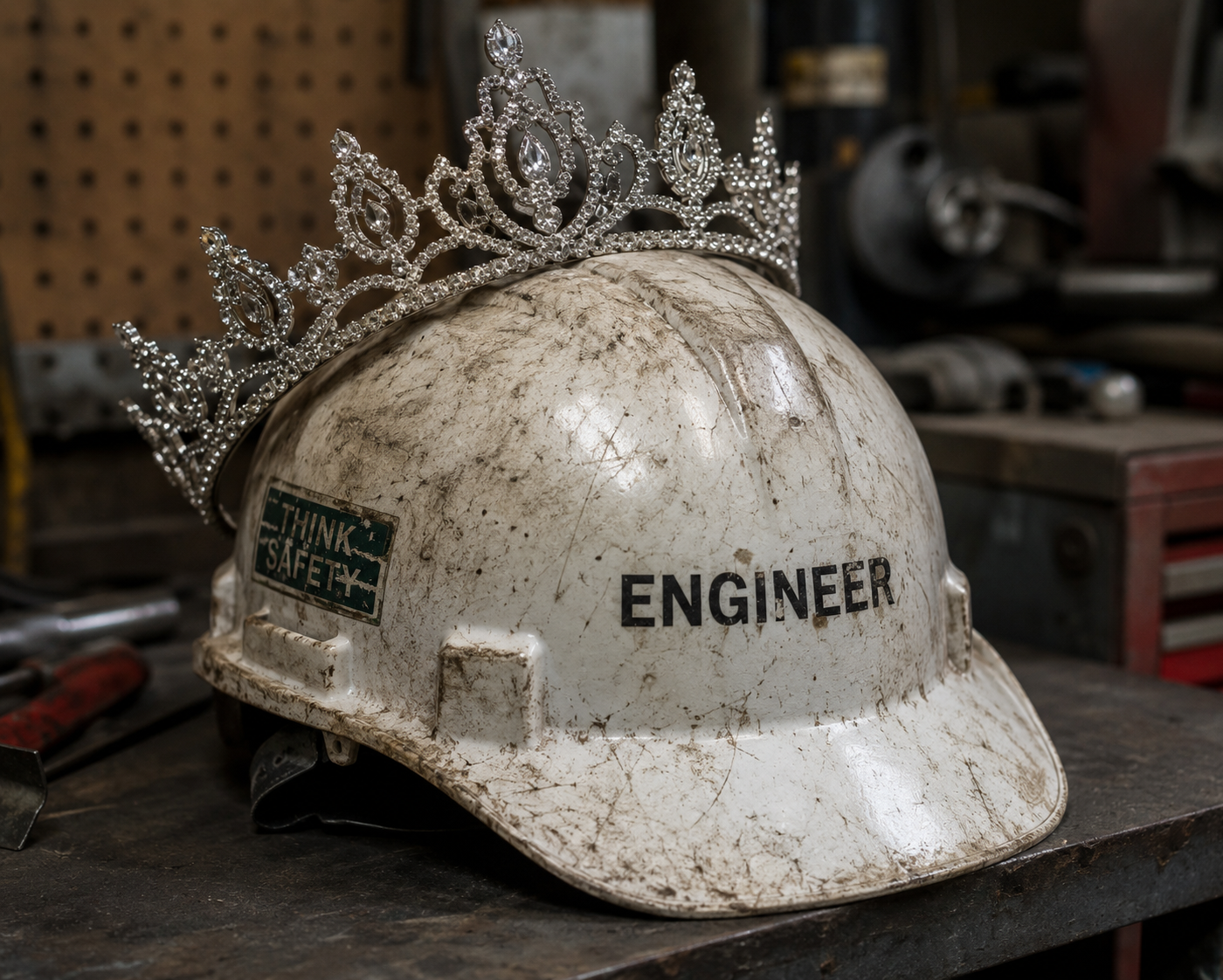
The Hard Hat and the Sparkly Hat Are the Same Tool
INWED 2026 Arc, Post 1 of 3
I taught myself to read at two and a half because waiting for someone to teach me wasn’t working.
In fairness, my mother had mid-century primers already staged in the house — because of course she did. She saw what was happening before I did, handed me the phonics rules, and explained the difference between a long vowel and a short one and what a silent letter was doing just sitting there, apparently decorative. I did the rest.
I want you to sit with that for a second — not because it’s impressive (although, objectively, it is), but because it tells you everything about how I have navigated every single system I have ever encountered since. Including academia. Including engineering. Including pharma. Including the one that handed me a performance improvement plan at age 25 and called it feedback.
I didn’t know then that I was autistic. I didn’t know I had ADHD. I had always known my mind could run faster than everyone else’s — that I was carrying multiple concurrent trains of thought while most people were still boarding the first one. I’d chalked it up to profound giftedness, since no professional I’d ever spoken to could name what they were looking at, regardless of my ability to articulate exactly what was happening. What I knew was that the work was never the problem. The system, and the people who staffed it, couldn’t keep up. And rather than examine that, it produced paperwork.
I’ve been handed a lot of paperwork in my career.
The Part Where I Tell You I Was Always This
My family has been in Pinellas County for seven generations. French merchant navigators who came here from Bretagne via New Orleans. My great-great-uncle Jerome helped build Gulfport’s social infrastructure and was still telling stories about the great 1921 hurricane for a St. Petersburg Times centennial piece in 1987. What I’m saying is: I come from a long line of people who show up, build things that last, navigate by their own charts, and absolutely do not wait for permission.
I was raised under a car hood, over a chemistry set, inside an everlasting home renovation, and beneath thirteen years of Catholic school hell.
At age 4, I was programming the family computer from library copies of 3-2-1 Contact because the computer was more cooperative than most adults I’d encountered. At 7, I had a chemistry set, with strict instructions to not “add anything to it”. At 11, a ballet school director informed me that my body was the wrong shape for the stage.
It took me twenty-five years to fully file that assessment under incorrect. That’s not a throwaway line. The culture of the ’90s and early 2000s made sure of it — heroin chic, the Zoebot era, hip huggers and hardware that wasn’t designed for anyone who looked like me. Being told, in ways both explicit and ambient, that public life wasn’t for people built like I was built. I held onto that for a long time. But I’m getting ahead of myself — that’s a whole other post.
What I did instead: basketball, then athletics (track) field events, then rugby, then engineering school, and eventually manufacturing floors where I was frequently the only woman in the room and where I learned that courage and confidence were more armor than steel toes and hard hats.
At 14, I started writing a sci-fi novel while in class. Not for an assignment. For self-regulation — though I didn’t have that word yet. My brain needed somewhere to go during the other thirty-five minutes after I’d finished an exam in fifteen.
At 25: the PIP. Which wasn’t actually about performance. My verbalized frustration with the institutional machinery — the inane iterative review cycles, the bureaucratic scaffolding that existed primarily to justify itself — had finally caught up with me. The system couldn’t name what I was, so it named what I was doing instead, and what I was doing was being impatient with processes that deserved impatience. The paperwork followed. I wasn’t surprised. I was annoyed. And as a perfectionistic eldest daughter of eldest daughter (x6 generations), I was hurt.
At 35: 58 out of 64 traits on an ASD checklist. 90.6%. Not broken. Different hardware. I had spent my whole life describing my mind as running a quad-core processor in a 286 world. Now it’s more accurately a quantum computer in an Atari 2600 world. Some days it still feels like the world is running UNIVAC.
None of this derailed me. It clarified me.
The Part Where I Tell You About the Sparkly Hat
I’ve been a licensed Professional Engineer since 2011. Chemical engineering. Life sciences validation — which means I’ve spent 25 years at the intersection of law and engineering, making sure pharmaceutical and biotech manufacturing processes work correctly, consistently, and in full compliance with FDA expectations. The client list has been, to use the technical term, epic. I know where the skeletons are in this industry. I know which ones have the probability of becoming zombified and biting someone in the ass. The clients who know me well know this about me, which is why certain conversations happen quietly and certain documents get very carefully revised before anyone official arrives.
I know what it means to be the woman at the table who has to be twice as precise before she’s taken half as seriously.
My platform — women’s STEM career retention and engineering leadership — isn’t something I picked up with a crown. It’s what I’ve been working on since before I had a title for it. I carried it into USA Ambassador in 2021. Into Emissary Pageants International Congress (EPIC) 2024. Into this year. It will be the platform after whatever comes next, regardless of which system’s stage I’m standing on. The crown changes. The mission doesn’t.
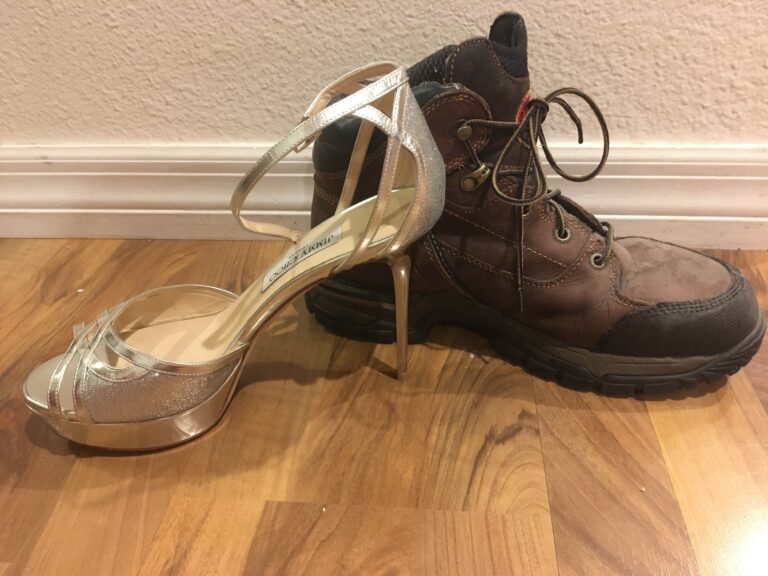
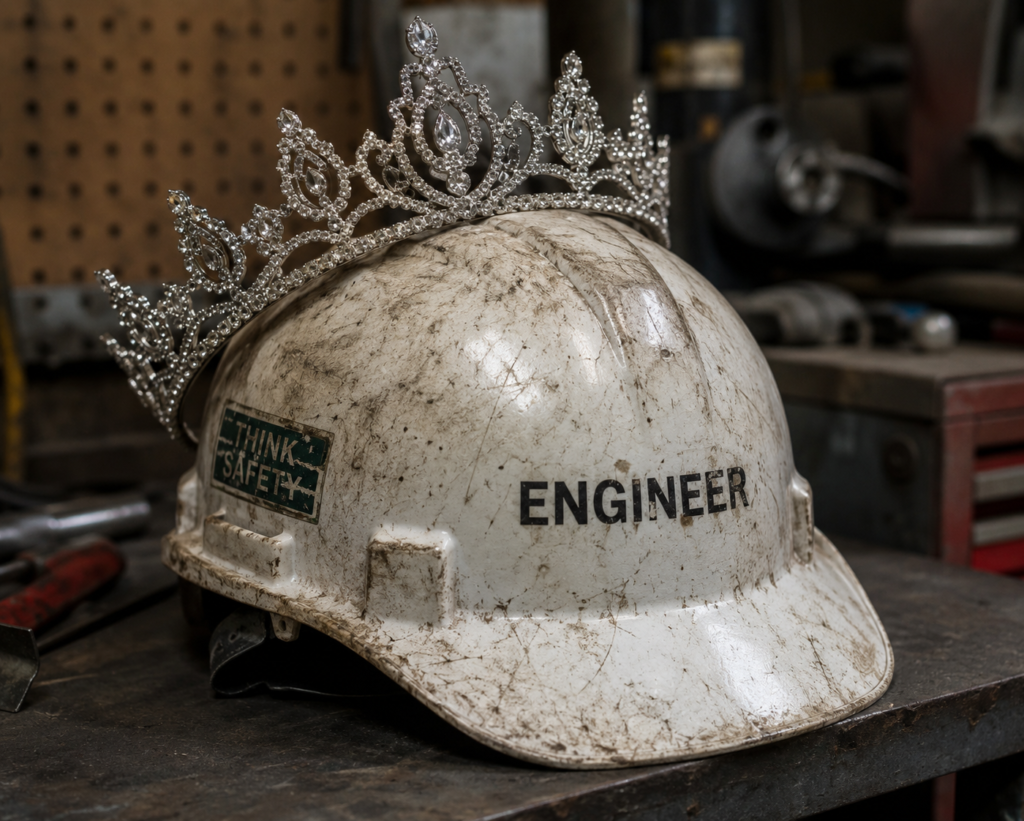
Here is what I have learned from five years of walking into rooms wearing one: while my colleagues may listen to me in a hard hat, everyone pays attention to the sparkly hat.
That’s not a joke. It’s a delivery mechanism. The crown doesn’t replace the credentials — it amplifies them. It gets the room’s attention so the credentials can do their work. I am a working engineer and a systems thinker and a person who once played rugby completely sober and who will, given half a chance, tell you exactly what’s wrong with how your industry retains its women.
The hard hat and the sparkly hat are the same tool. They both say: I am here. I am qualified. Pay attention.
The Part Where This Becomes About You
June 23rd is International Women in Engineering Day — INWED.
Over the next two weeks, I’m going to be writing about the structural reality of what it means to be a woman in engineering in 2026. The data. The pipeline math. The barriers that aren’t about women not being capable or not being interested or not “leaning in” hard enough.
I’m going to write about what it actually costs organizations — in dollars, in institutional knowledge, in operational continuity — when they lose a senior woman engineer. About what retention looks like when it’s done right versus when it’s a lanyard and a “women in leadership” lunch.
And on June 23rd, I’m going to publish the most personal piece I’ve written here. The full arc. The whole story. What “too much” actually costs, when it’s directed at a child who is simply faster than her environment.
I’ve been building toward this for twenty-five years. I didn’t know that’s what I was doing. Turns out I was taking notes the whole time.
Come with me over the next two weeks.
— Rebecca, PE
Founder, PT&P Solutions LLC | Mrs. Florida Emissary 2026 | Co-host, The Athena Factor
This is the first post in the INWED 2026 arc.
[Next: The 2.25% Problem — What the Pipeline Math Actually Shows.]
[INWED June 23: What “Too Much” Costs.]