Stack That Chaos!
Let’s talk about the thing I built because everything else was garbage.

Not the concept. Not the brand. The actual thing —specifically, the twenty pages of engineer-built, neurodivergent-tested, fully loaded life-approved systems I’m giving away for free. But first, a confession.
I Am, At My Core, A Bargainista
If you’ve followed me for any length of time, you know about the #ThriftHeist. This is what I call the sport of finding exceptional things at non-exceptional prices — the $4 blazer that fits like it was made for you, the 14K gold jewelry at the estate sale, the complete set of stemware at Goodwill that someone donated because they got divorced and couldn’t look at it anymore. Their loss. My poolside margaritas.
I approach productivity the same way.
Before I build anything, I look for what already exists. I am not too proud to use someone else’s system if it works. I have tried the planners. I have tried the apps. I have tried the color-coded binders, the bullet journals, the habit trackers, the morning routines designed by people who apparently do not have children or jobs or brains that operate at seventeen tabs simultaneously.
I gave every single one of them a fair shot. And every single one of them failed me in the same fundamental way: they were built for a life that is simpler than mine.
They assumed a brain that executes linearly. They assumed a schedule with actual margins in it. They assumed that the primary obstacle to productivity is motivation, rather than cognitive load, decision fatigue, sensory overwhelm, and the fact that someone always needs something right when you’ve finally found your flow state.
I am a licensed Professional Engineer with twenty-five years in life sciences, ADHD, ASD, triplet daughters, a cocker spaniel, three cats running an unlicensed enterprise, and a husband who is, bless him, essentially the fourth child. My life does not fit in a planner.
So I stopped looking for one and built something else entirely.
What The Chaos Stack Actually Is
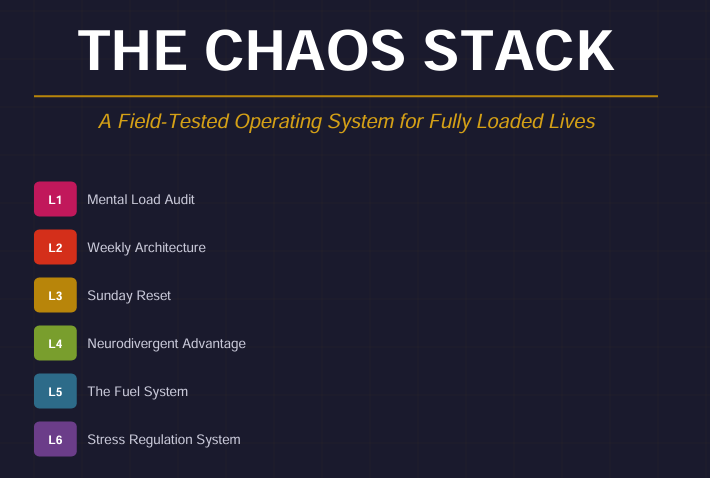
The Chaos Stack is not a productivity system in the traditional sense. It is an operating system — the kind that runs in the background, manages resources, handles interruptions, and keeps everything from crashing simultaneously.
It is not going to tell you to wake up at 5am. It is not going to ask you to journal your feelings before the sun rises (more power to you if you do). It is not going to suggest that the reason your life feels unmanageable is because you haven’t found your why.
Your life feels unmanageable because it is complex. Full stop. The solution is not inspiration. It is architecture.
Six layers. Here’s what each one does.
Layer 1 — The Mental Load Audit
You cannot manage what you haven’t mapped.
The mental load is the invisible work — the constant background processing of everything that needs to happen, might happen, should have happened, and will definitely happen at the worst possible moment. It is the reason you wake up at 3am with a sudden, vivid memory that you forgot to schedule the dentist. It is the reason you feel exhausted before you’ve done anything.
The Mental Load Audit is how we get it out of your head and onto paper. All of it. Every task, every recurring responsibility, every thing you are currently tracking in your brain because you haven’t yet built a system for it.
It is not a to-do list. It is an inventory.
You cannot build a system for managing your load until you know what your load actually is. This is where we start, every time, without exception.
Layer 2 — The Weekly Architecture
Structure that bends without breaking.
Time blocking gets a bad reputation, and I understand why — because most time blocking systems are built on the assumption that your time is yours to block. For people with demanding jobs, kids, neurodivergent brains, and lives that do not respect the calendar, rigid time blocking is a setup for constant failure.
The Weekly Architecture is time blocking for people whose time never actually goes according to block.
It builds in flex. It accounts for the interruptions that are not interruptions — they are just the actual shape of your life. It creates a framework that tells you, at any given moment, what the priority is and what can wait — without requiring you to make that decision from scratch every single time.
Because decision fatigue is real, and every decision you make costs cognitive currency you might need for something else.
Layer 3 — The Sunday Reset
Non-negotiable. Full stop.
I will not negotiate on the Sunday Reset. I have tried skipping it. I know what the week looks like when I do, and the answer is: worse. Measurably, demonstrably, quantifiably worse.
The Sunday Reset is one session — two hours, maybe less if you’re practiced — that stages the entire week. Meals planned. Calendar reviewed. Priorities set. The things that would otherwise ambush you on a Tuesday at 4pm, identified in advance and dealt with before they become crises.
It is not about being Type A. It is not about control. It is about giving your future self a fighting chance.
My future self, on the Mondays that follow a proper Sunday Reset, is calm and capable. My future self, on the Mondays that don’t, is feral.
I prefer the first version.
Layer 4 — The Neurodivergent Advantage
Let me be direct about something.
This layer is not called the Neurodivergent Advantage because I think ADHD and ASD are superpowers in the motivational-poster sense. I think that framing is well-intentioned and functionally useless. “Your ADHD is actually a gift!” does not help you when you’ve missed the same deadline three times because your brain genuinely does not process time the way other brains do.
It’s called the Neurodivergent Advantage because, once you stop trying to operate your non-standard brain like a standard one and start engineering around its actual architecture, things that used to be constant friction points become manageable. Sometimes even leverage.
ADHD. ASD. The brain that runs seventeen tabs and somehow still crashes on the one thing that mattered. The brain that can hyperfocus for six hours on something interesting and cannot sustain five minutes of attention on something it finds boring, regardless of how important that thing is.
This layer is not about fixing anything.
Your brain is not broken. It is different. And different requires different systems — not harder effort, not better attitude, not more willpower. Different systems. Built for the brain you actually have.
Layer 5 — The Fuel System
Food is infrastructure.
I will say it again: food is infrastructure. It is not a reward. It is not a lifestyle. It is the fuel your brain and body run on, and if you are making food decisions at 6pm when you are exhausted and everyone in your household is hungry and opinionated about what they want for dinner, you are making decisions from the worst possible cognitive position.
One two-hour session on Sunday eliminates five evenings of 6pm decision fatigue.
This is not a diet. I am not going to tell you what to eat. I am going to tell you that the decision of what to eat needs to happen when you have the cognitive bandwidth to make it, not when you’re standing in front of an open refrigerator at the end of a long day wondering if cereal counts as dinner.
(It does, sometimes. But it should be a choice, not a default.)
The Fuel System is a logistics problem with a logistics solution. Meal rotation. Batch prep. Decisions made in advance so that future you has one fewer thing to figure out in real time.
Layer 6 — The Stress Regulation System
This is the one people skip. It is also the one everything else depends on.
Stress regulation is not self-care in the spa-day, treat-yourself sense. It is the physiological management of a nervous system that is being asked to do a lot, constantly, often without adequate recovery.
There are three kinds of stress this layer addresses: acute, chronic, and physiological. They are different problems that require different interventions, and conflating them is why “self-care” advice so often feels useless — because taking a bath does not address a chronically dysregulated nervous system, and a breathing exercise does not fix a body that hasn’t slept properly in six months.
Because “self-care” is not a bath bomb. It is a protocol.
The Stress Regulation System maps your personal warning signs, builds your acute intervention toolkit, and protects the recovery floor — the non-negotiable baseline of sleep, movement, and physiological regulation — that makes all of the other five layers actually function.
You can have the best weekly architecture in the world. If your nervous system is in constant overdrive, none of it will work.
Why It’s Free
Twenty pages. Fillable. Printable. Free.
A few people have asked me why I’m giving this away. The honest answer is two parts.
Part one: I am a bargainista. I believe that the best things should be accessible. I spent years looking for something like this and couldn’t find it, and the reason I couldn’t find it wasn’t that it didn’t exist — it was that the versions that came close were buried behind $97 course paywalls and email funnels and webinar series hosted by people who had never actually run a household that looked anything like mine.
I built this for the person I was five years ago. She didn’t have $97. She had ADHD, three kids, a demanding job, and a deep need for something that would actually work.
Part two: if you download this workbook and it helps you — if it does what I built it to do — you’ll be back. And when you’re back, we can talk about the other ways I can help you.
That’s the deal. The workbook is free. The relationship is the point.
Go get it. It’s waiting for you at pinktoolsandpearls.com/chaos-stack.
— Rebecca
Licensed PE. Founder. Recovering chaos-manager. Originator of the #ThriftHeist. All systems go.