Here’s What “Too Much” Cost Me.
I have been a licensed Professional Engineer since 2011.
I have spent 25 years at the intersection of law and engineering, ensuring pharmaceutical, medtech, and biotech manufacturing processes work correctly, consistently, and in full compliance with FDA expectations. I have worked with some of the largest life sciences companies in the world. I have been, on many occasions, the only woman in the room.
I am also a triplet mom. A retired rugby player. A pageant titleholder. A podcaster. A bargain hunter. An operatic diva. A systems thinker who built a six-layer productivity framework because everything else on the market was designed for a life simpler than mine. A happy wife; and I earned that MRS, thankyouverymuch.
I am, by every available measure, still here.
And I want to tell you what it cost.
The Part Where I Tell You I Didn’t Have To Be Here
I am a multipotentialite. I could have succeeded in most any career path, except maybe medicine, because I would be Dr. House with a caffeine addiction. There are some serious Darwin Award candidates out there who deserve that kind of bedside manner. Engineering was going to give me the best opportunities for scholarship money (which I needed to attend college at all) and the best long-term financial stability. A strategic choice, made with full awareness of the alternatives.
What I discovered after the fact is that the old guard has a word for what I am. They call it “the knack.” The inborn systems and analytical thinking, the Dilbert reference. The thing you either have or you don’t.
I have it. Nerves of steel. A brass pair. I am still waiting for someone to put a pair of brass spheres on my desk toy shelf. And I am a cracking good engineer. That is not bragging. It is a technical assessment, and precision matters in my field.
The Price of Staying
Not the dramatic version. The real version: the one that accumulates in increments over twenty-five years, so gradually that you don’t always notice what’s being extracted until you take inventory.
It cost me the performance improvement plan at twenty-five. The one that wasn’t about performance. The one that was about the system not having a category for what I was – someone who ran faster than the process, who had already identified the inefficiency before anyone else had opened the meeting agenda, who expressed that observation out loud in a room that wasn’t ready to hear it. That document didn’t break me. But it established the pattern: being right and being heard are two different things, and the gap between them has a toll.
It cost me my job at twenty weeks pregnant with the triplets. I was put on bedrest, not uncommon in a higher-order multiple pregnancy, and forced onto FMLA. What I remember from that time, besides the medical reality of carrying three humans simultaneously, is my female coworkers telling me they were relieved it was me having the triplets. Because my mind, they said, would be the most capable of managing a triplet household. They weren’t wrong. That’s the part that stings.
When the pregnancy ended, when I had three daughters and was eight weeks postpartum, delirious from sleep deprivation and still relearning how to walk from muscle atrophy, the company informed me they did not have sufficient workload to bring me back. This was the same company whose entire 2014 life sciences project pipeline I had personally scoped. I found the timing difficult to believe. I found another job anyway, four months postpartum with newborn triplets, because I didn’t have a choice. That job required relocating from Cincinnati to Columbus. I eventually moved back to Florida for family support that never fully materialized, but that’s another post.
What followed was six years, 2016 to 2022, of taking the jobs I could get rather than the jobs I deserved. Toxic environments. Lateral moves. The kind of professional situation you accept because the alternative is worse, and because you have three kids and a mortgage and the math doesn’t leave room for pride. COVID hell, surrounded by actual masks which are my autistic trigger. Those six years extracted a toll I am still accounting for.
Then there was the behavioral masking. Or rather: the failure to mask. Being neurodivergent in environments that wanted a smaller, quieter, more legible version of my brain — and not having the neurological toolkit to perform that shrinking convincingly. The ratchet of small corrections that added up to a cage. The repeated failure to successfully perform ordinary. The exhausting, losing effort of trying to compress a quantum computer into a format the UNIVAC could process without crashing.
I didn’t eventually choose to stop making myself smaller. I stopped being able to maintain the performance. And then, slowly, I stopped believing it was my job to try.
That last part — the stopping — was the work of years. It is, honestly, still ongoing.
What Kept Me Here
I love this work. That is not a small thing. I am genuinely, constitutionally suited to what I do: the systems thinking, the precision, the particular satisfaction of a validation package that is airtight and defensible under the most adversarial conditions. This is not what I do despite who I am. It is an expression of who I am.
But love for the work is not sufficient to keep women in engineering. If it were, we would not have a 2.25%.
What kept me was a combination of factors I’ve come to understand as structural advantages I was lucky to have, not personal qualities that women who left simply lacked.
There is a saying among STEMinists: a successful woman in STEM must have a supportive partner, or none at all. I have Michael – a husband who made a deliberate, pre-negotiated agreement before we ever had children that I would be the primary breadwinner and he would be the primary caregiver. I want to be precise here: I still carry a double shift. Triplets make both parents carry double shifts, sometimes triple. What I have is a partner who carries his half of the impossible load rather than leaving it to me by default. The data on who carries the household labor is unambiguous, and I have watched my colleagues do this alone for twenty-five years. Having someone to carry it with you is not a small thing. Most women in engineering do not have it.
I also had the brain for it. Wired in ways that made the cognitive intensity of this work not depleting but generative. That is not available on demand.
And I had, eventually, the willingness to stop performing smallness. Which, as I said, took considerably longer than it should have.
The Crown Is Not a Contradiction
I am Mrs. Florida Emissary 2026. Before that, Mrs. Florida Emissary 2024, and the first runner-up at EPIC nationals. I sat out 2025 due to budget constraints and came back for 2026. Before that, Mrs. Florida Ambassador 2021, where I won the Resume Competition. As it should be.
My platform has been the same across every title: women’s STEM career retention and engineering leadership. The crown changes. The mission doesn’t.
People sometimes find this combination surprising. A PE and a pageant title. An engineering consultant and a sash. As if technical excellence and deliberate femininity are categories that shouldn’t coexist; as if walking onto a stage in an evening gown is incongruent with twenty-five years of FDA-regulated manufacturing experience.
I want to be direct about this.
The stage was always mine. It took me twenty-five years to fully believe it. Past the ballet school director who told me my body was the wrong shape, past the culture of the ’90s and early 2000s that had very specific ideas about whose body belonged in what kind of public space, past the institutional machinery that preferred me useful and quiet over visible and loud.
The crown is not a departure from my engineering identity. It is a delivery mechanism for it. While my colleagues may listen to me in a hard hat, everyone pays attention to a sparkly hat. The credentials do the work. The crown gets the room’s attention so the credentials can.
You do not have to choose between technically excellent and fully yourself.
That sentence took me twenty-five years to write without qualifying it. I am not going to qualify it now.
What I Want For You
If you are a woman in engineering reading this, whether you are twenty-two and just starting, or forty-five and deciding whether you have another decade or three of this in you, I want you to know that the cost you are paying is real. It is not imaginary. It is not weakness. It is the predictable output of a system that was not designed with you in mind and has been positively glacial to redesign itself.
And I want you to know that the cost is not fixed. It is the current price, in the current system, and systems can be changed.
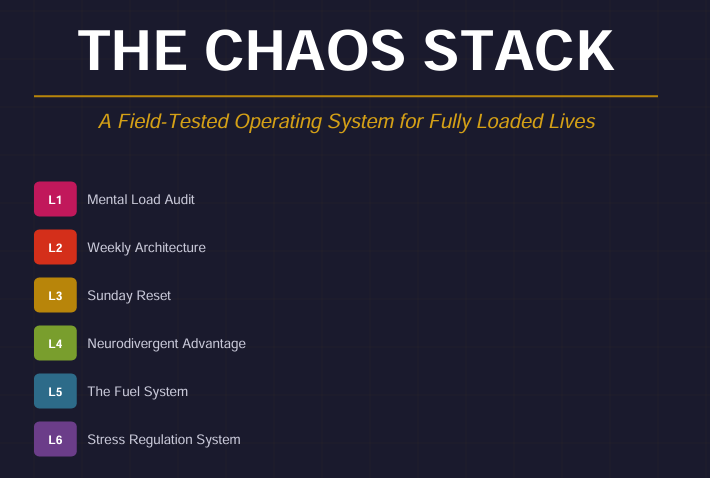
That is what The Athena Factor is about. That is what this platform is about: the engineering and the triplets and the chaos systems and the crown and the twenty-page workbook I give away for free, because the person I was fifteen to twenty years ago needed it and couldn’t find it.
All of it is the same thing. Systems thinking applied to a life. Precision tooling. Pearls of wisdom.
Today is International Women in Engineering Day.
I am still here. And I am not done.
Happy INWED.
Rebecca, PE
Founder, PT&P Solutions LLC | Mrs. Florida Emissary 2026 | Co-host, The Athena Factor
This is the third and final post in the INWED 2026 arc.
[Post 1: The Hard Hat and the Sparkly Hat Are the Same Tool]
[Post 2: The <3% Problem: What the Pipeline Math Actually Shows]
CTA: If any part of this resonated — if you are the woman who is still here, barely, doing the math — The Chaos Stack workbook is free. Twenty pages of systems built for the life you are actually living. Go get it.